
Plantar Fasciitis & Heel Pain: A Complete Australian At-Home Relief Guide
It has a signature move, this one. You swing your legs out of bed, put your foot down, and the first few steps feel like walking on a stone bruise, or a hot nail through the heel. Then it eases as you get moving, lulls you into thinking it’s fine, and ambushes you again after you’ve been sitting a while or at the end of a long day on your feet.
That pattern of pain on the mornings fist steps is the calling card of plantar fasciitis (increasingly called plantar heel pain or plantar fasciopathy by clinicians). It is the most common cause of heel pain in Australian adults. It’s stubborn, it’s genuinely painful, and it has a habit of hanging around for months when it’s ignored or managed badly. The good news is that the large majority of cases settle with consistent at-home care, and almost everything that works is simple, cheap, and in your control.
This guide covers what plantar fasciitis actually is, why mornings are the worst, when heel pain needs a professional instead of a blog article, and a realistic at-home plan. This includes load management, stretches that have the best evidence behind them, footwear, ice, massage, and compression, plus honest timelines and the mistakes that keep people stuck.


This guide is general information for Australian adults and is not a substitute for advice from your GP, physiotherapist, or podiatrist. If your heel pain is severe, follows an injury, or isn’t improving after several weeks of sensible self-care, please get it assessed, persistent heel pain has several causes, and the right diagnosis changes the plan.
Most heel pain is plantar fasciitis. Not all of it is, and a few patterns deserve a professional’s eyes early rather than months of guessing:
See your GP promptly if the pain started with a sudden pop or snap during activity, if you can’t bear weight on the foot, if the heel is hot, red or significantly swollen, if you have a fever alongside foot pain, or if you have diabetes and any new foot pain or skin change. Diabetic feet always need a lower threshold for getting checked.
Book a podiatrist or physio if the pain includes numbness, tingling or burning (that pattern points more toward a nerve than the fascia), if the pain sits at the back of the heel rather than underneath it (more likely the Achilles), if it’s waking you at night, or if six to eight weeks of the genuine self-care below hasn’t moved the needle. In Australia you don’t need a referral to see a podiatrist privately, and if you have a chronic condition your GP may set up a Medicare chronic disease management plan that covers part of a small number of allied health visits, which is worth asking about.
None of this is meant to alarm, it’s triage. If your pain is the classic under-the-heel, worst-with-first-steps variety and none of the above applies, read on; you’re in the right place.
The plantar fascia is a thick band of connective tissue running from your heel bone to the base of your toes, like a bowstring under the arch of your foot. Every step you take, it stretches and springs back, absorbing load and helping propel you forward. It handles enormous forces all day, every day, and mostly does it without complaint.
Plantar fasciitis is what happens when the load on that tissue outpaces its capacity to recover. Despite the “-itis” name, it’s less a raging inflammation and more an overload and degeneration problem. The fascia’s attachment at the heel becomes irritated, thickened, and painful. That reframe matters, because it explains why the fix isn’t just “reduce inflammation” but “manage load and rebuild capacity”, and this is why it takes weeks, not days.
The morning mystery, solved: overnight, with your foot relaxed and pointed, the fascia rests in a shortened position and the irritated tissue begins healing in that shortened state. Your first steps stretch it abruptly back to working length, hence the stone-bruise-and-hot-nail routine. It’s also why the pain eases with movement (the tissue warms and lengthens) and returns after rest. Nothing about that pattern means you’re making it worse by walking; it’s just the tissue’s grumpy wake-up call.
Plantar fasciitis is an overload problem, not a raging inflammation, which is why the fix is load management and rebuilding capacity rather than just settling swelling.
Usually it’s not one thing but a stack of them: a sudden increase in walking, running or standing (a new job on your feet, a holiday spent walking, a New Year running program), body weight changes that increase load on the fascia, calf muscles that have gotten tight (they and the fascia share the load, and when calves are stiff, the fascia picks up the slack), lots of time barefoot or in flat, unsupportive footwear on hard floors, or simply being in the 40-to-60 window when tissue capacity naturally dips. Standing occupations (nursing, teaching, retail, trades) are heavily represented. None of it is a character flaw; it’s a maths problem between load and capacity.
COMMON CAUSES


Everything below is aimed at the same two goals: calm the irritated tissue, and rebuild its capacity so it stops being so easy to irritate. Expect to run this plan for weeks, consistently. Plantar fasciitis rewards boring persistence and punishes sporadic enthusiasm.
Complete rest feels intuitive and mostly backfires. The fascia weakens further and complains harder when you return. The smarter move is trimming the spikes: fewer consecutive hours standing on hard floors, breaking long walks into shorter ones for a few weeks, swapping some running for cycling or swimming, and avoiding barefoot time on tiles and floorboards while things are cranky. Keep moving; just shave the peaks off.
The two stretches with the best track record cost nothing and take five minutes:
Wall calf stretch
Hands on the wall, sore-side leg back with the heel down, front knee bending until you feel the pull in the back calf. Hold around 30 seconds, repeat a few times, then repeat with the back knee slightly bent to reach the deeper calf muscle. Do it two or three times a day. Before getting out of bed is prime time.
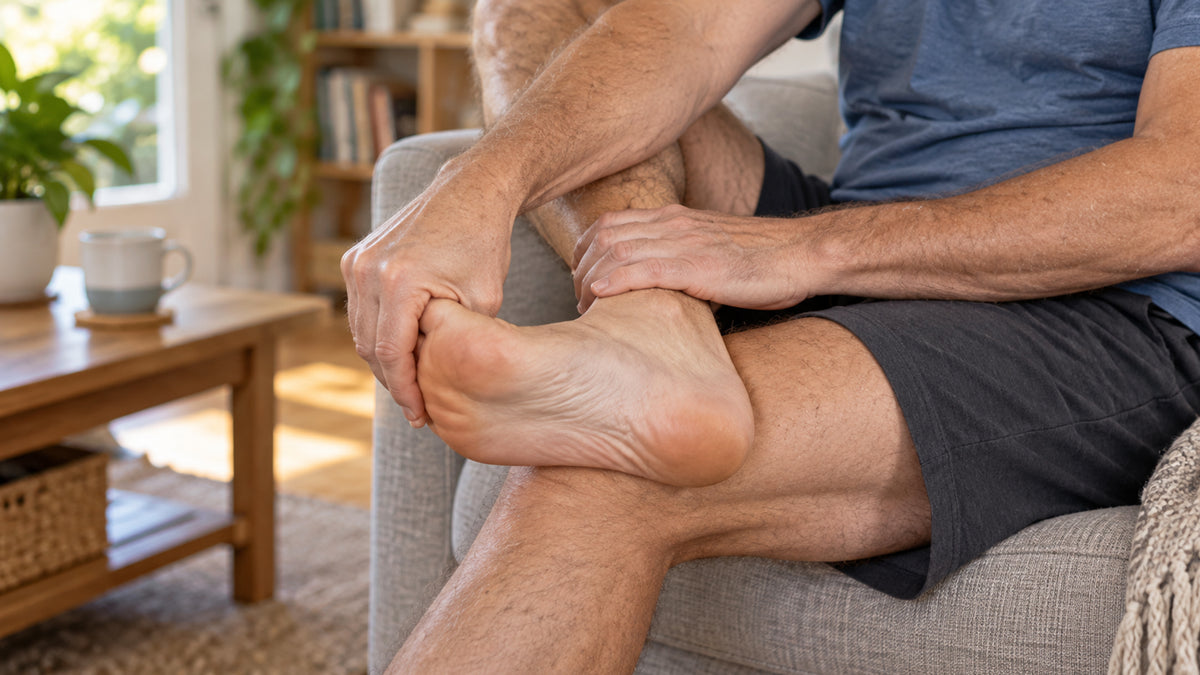
Plantar fascia stretch
Sitting, cross the sore foot over your other knee, grab the toes and pull them back toward the shin until you feel the stretch along the arch. Hold about 30 seconds, a few repeats, especially before your first steps in the morning and after sitting. This specific stretch has performed well in clinical trials against pretty much everything else.
Frozen bottle or ball roll
A frozen water bottle or a firm ball rolled slowly under the arch for a couple of minutes combines massage and cold in one lazy, effective package, and can be a favourite for end-of-day flare-ups.

Find Relief with Our Plantar Fasciitis Range
Compression sleeves, wraps and support for the weeks of healing.
Shop NowFor the next couple of months, think of supportive shoes as part of the treatment: cushioned, with decent arch support and a slightly raised heel, worn from your first steps rather than after breakfast. Many people find keeping a pair of supportive recovery slides or cushioned house shoes beside the bed so that the foot never lands raw on a hard floor. This makes a bigger difference than any single gadget. Off-the-shelf orthotic insoles can help too. They don’t need to be expensive to be useful, and a podiatrist can advise if your feet need something more tailored.
These don’t heal the fascia on their own, the loading and stretching does that, but they make the weeks of healing considerably more livable:
Compression: a snug foot and ankle compression sleeve supports the arch, reduces the end-of-day ache and swelling, and gives the foot a gentle “held” feeling that many people find makes long shifts manageable. Wear it during the day, not to bed. (We’ve written before about how compression sleeves work for foot and leg pain if you want the deeper dive.)
Massage: slow, firm strokes along the arch with a thumb, ball, or a massage device eases the protective tightness that builds through the foot and calf. An EMS foot massage mat can be a convenient hands-free way to give the feet a daily massage session while you’re sitting anyway.
Cold: ten to fifteen minutes of ice (wrapped, never direct on skin) after aggravating days takes the edge off. Heat, by contrast, tends to feel nicer on the calf than on the acutely sore heel, experiment and let your foot vote.
Once mornings are merely stiff rather than eye-watering, add capacity: slow calf raises (both legs, progressing to single-leg, a towel rolled under the toes makes them extra fascia-specific), toe scrunches with a towel on the floor, and short barefoot balance work on soft surfaces. Strong calves and feet are the best insurance against a repeat, and if you’re building a broader home strength habit, our resistance band guide for seniors covers safe lower-leg work in more detail.
One supportive-shoe habit, two stretches done daily, and one comfort tool used consistently will outperform a drawer full of gadgets used for a week each.
Pushing through big spikes. A little discomfort during activity that settles within a day is acceptable; pain that’s worse the next morning than the one before is your load ceiling talking. Respect it.
Complete couch rest. Deconditioned tissue is fragile tissue. The goal is managed load, not none.
Heel spur panic. If an X-ray ever shows a heel spur, don’t despair. Plenty of pain-free feet have spurs and plenty of painful feet don’t. The spur is usually a bystander; the fascia is the story, and the treatment doesn’t change.
Buying everything at once. One supportive-shoe habit, two stretches done daily, and one comfort tool used consistently will outperform a drawer full of gadgets used for a week each.
On pain relief medication: short-term over-the-counter options can help some people through the worst patch, but what’s appropriate depends on your health and other medications. That’s a conversation for your pharmacist or GP, not something we’ll dose from a blog.
With consistent care, most people notice mornings improving within four to six weeks, and the large majority of cases resolve within several months to a year. That’s slower than anyone wants, but it’s the truth. The people who do worst are the ones who stop the plan the first week the pain eases, flare, get discouraged, and repeat. If you’ve done six to eight genuine weeks of the above with no improvement, that’s not failure; that’s your cue for a podiatrist or physio, who can add options like taping, tailored orthotics, shockwave therapy, or a structured strengthening program, and rule out the imposters (fat pad problems, nerve entrapment, stress fracture).
Plantar fasciitis is one of the most fixable chronic pains there is, but it just refuses to be fixed quickly. Calm it down with load management, ice and support; stretch the calf and fascia daily like it’s brushing your teeth; wear real shoes from the first step of the day; and rebuild strength as it settles. Give it weeks of boring consistency, and the morning hot-nail routine fades to a memory. And if it doesn’t, you’ll walk into the podiatrist having already done everything right, which makes their job, and your recovery, faster.
Frequently Asked Questions
No, walking in supportive shoes, in amounts that don’t spike next-morning pain, is fine and probably helpful. Trim the volume, don’t quit. The exception is genuinely severe cases where every step hurts; that’s a get-assessed situation, not a push-through one.
For the acutely sore heel, ice generally wins, especially after long days. Heat suits the tight calf above it. Many people do both. They use warmth and stretching for the calf, and cold under the heel. Neither is doing the deep healing, both are legitimately there for comfort.
They help with symptoms such as arch support, less end-of-day ache and swelling, more comfortable long shifts, and that comfort makes it easier to stay active, which does drive recovery. They’re a genuinely useful supporting player rather than a standalone cure, and that’s exactly how we’d suggest using them.
It can, especially if the original recipe reassembles: load spike plus tight calves plus flat shoes. Your insurance policy is keeping the calf stretches and calf raises in your week after recovery, staying sensible with footwear on hard floors, and easing into any new activity program rather than lurching. Most repeats are milder and settle faster because you’ll recognise it early and know the drill.


